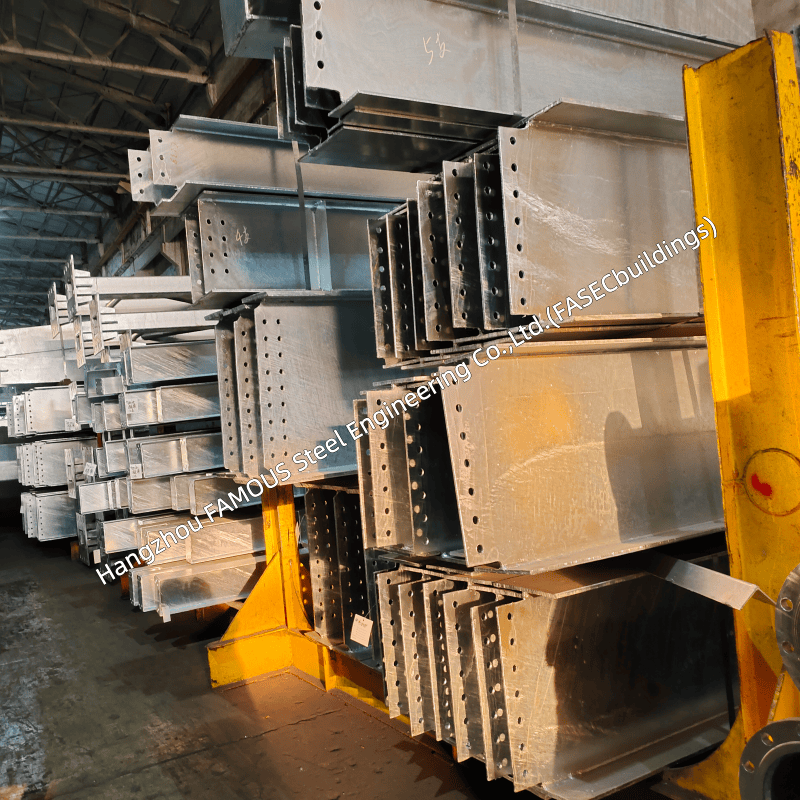
HOT DIP GALVANIZED STEEL
Hot Dip Galvanized H Beam and Steel Columns
The steel is fully fabricated first, then dipped in molten zinc at 450 degrees, so every surface inside and out is coated, including the cut edges, the bolt holes and the weld toes.
65 to 200 microns | ASTM A123 and EN ISO 1461 | 20 to 30 years outdoor life | No site painting
Why Hot Dip Galvanizing Works
Paint protects steel by sealing it, and once the film is scratched the rust starts underneath. Zinc works in two ways.
It seals the steel as a barrier, and when the coating is damaged the zinc around the damage corrodes first and protects
the steel beside it. That second effect is called sacrificial protection, and it is the reason a galvanized frame
survives a scratch, a cut edge or a site accident that would start rust on a painted frame.
Because the coating is metallurgically bonded rather than applied on the surface, it does not peel off under impact
and it does not need to be touched up every few years. For an outdoor steel frame this usually means no maintenance
painting for 20 to 30 years, depending on the atmosphere.
One rule matters more than any other: all cutting, drilling and welding must be finished before dipping. A hole drilled
after galvanizing leaves bare steel inside the hole, and that is where corrosion begins.
Coating Thickness by Environment
Indoor and dry, C1 to C2. 45 to 65 microns is enough for warehouses, workshops and covered structures away from moisture.
Urban and industrial, C3. 65 to 85 microns for city buildings, light industry and areas with moderate pollution.
Coastal and chemical, C4. 85 to 115 microns for ports, seaside plants, water treatment and fertilizer facilities.
Severe marine and heavy industry, C5. 115 to 200 microns, often combined with a top coat, for offshore, shipyard and heavy chemical exposure.
Tell us the site location and we will recommend a coating class. If the frame will be visible, a duplex system of galvanizing plus a colour top coat gives both protection and appearance.
Designed for Dipping, Not Just for Strength
Vent and drain holes. Every hollow section and every overlap gets a hole at the highest and lowest point, so air escapes and zinc flows out. Without them the member traps zinc and distorts.
No closed chambers. Sealed boxes are never left in the design, because trapped air can burst the section in the zinc bath and trapped liquid can drip for days.
Distortion control. Thin plates and long slender members are dipped in a controlled sequence, and asymmetry in the section is avoided, so the member comes out straight rather than bowed.
Thread and machined faces. Threads are protected or re-tapped after dipping, and machined contact faces are masked so the fit is not changed by a 100 micron layer of zinc.
Marking before dipping. Piece marks are applied with a method that survives the zinc bath, so the mark and the member number match the packing list on site.
Specifications
| Steel grade | Q235B, Q345B, Q355B, S235JR, S355JR, S355J2, ASTM A36, A572 Gr.50 |
| Section type | Hot rolled H beam, welded H beam, universal column UC, H section column, built up plate girder |
| Section size | Web 100 to 1200 mm, flange 100 to 500 mm, plate 6 to 40 mm, length up to 12 m |
| Zinc coating | 65 to 200 microns, average and minimum per ASTM A123 and EN ISO 1461, measured on every batch |
| Duplex option | Galvanizing plus primer and RAL top coat, total system designed for the site corrosion class |
| Fabrication | Cut, drilled, welded, vented and marked before dipping, threads protected or re-tapped afterwards |
| Welding standard | AWS D1.1, EN 1090-2, GB 50661, welders certified to EN ISO 9606 |
| Inspection | Coating thickness report, adhesion check, visual check, dimensional check, MTC 3.1, SGS or BV |
Where Galvanized Frames Pay Off Most
Coastal and port structures. Salt spray attacks paint films quickly, while zinc handles it for decades.
Water treatment and chemical plants. Constant humidity and chemical vapour are exactly the conditions where repainting is expensive and frequent.
Agriculture and livestock buildings. Ammonia from animals destroys ordinary coatings; galvanizing is the standard answer.
Cold storage and food plants. Washdown water and hygiene rules make a maintenance free coating valuable.
Remote sites. If sending a painting crew back to site costs more than the steel, galvanizing is the cheaper choice over the life of the building.
Life Cycle Cost, Not Just Price Per Ton
A painted frame usually needs a first maintenance coat within 5 to 8 years, and a full repaint within 12 to 15 years in
a coastal or industrial site. Add scaffolding, surface preparation, labour and production downtime, and the second
coat often costs more than the original protection.
A galvanized frame normally needs no maintenance painting within 20 to 30 years. When you compare the two over the life
of the building rather than at the purchase order, galvanizing usually wins in C3 environments and almost always wins
in C4 and C5.
How We Control Galvanizing Quality
Coating thickness is measured with a magnetic gauge at a set number of points per member, and the results are recorded in the inspection file with the batch number.
Adhesion is checked by a knife or tap test, and the coating is inspected for runs, lumps, bare patches and ash inclusions before packing.
Small bare spots from handling are repaired with a zinc rich compound to the same standard as the bath coating, and the repair is recorded.
Members are stacked with spacers so air circulates, because wet galvanized steel packed tightly develops white rust, which looks like a defect even though it is only a surface film.
About Our Company
Hangzhou FAMOUS Steel Engineering Co., Ltd. was established in 2000 and works as manufacturer, fabricator and exporter
of steel structures. With 1200 to 1300 employees, about 8000 metric tons of monthly capacity and annual sales of
USD 500 to 600 million, we supply galvanized frames to more than 60 countries in Europe, North America, the Middle
East, Africa and Southeast Asia.
We hold ISO 9001 and CE marked fabrication to EN 1090, and our welders are certified to EN ISO 9606. Fabrication and
galvanizing are planned together, so the vent holes, the drain holes and the dipping sequence are decided at the
drawing stage rather than discovered in the bath. More about us at www.structural-steelbuilding.com.
ASTM A123 | EN ISO 1461 | ISO 9001 | CE EN 1090 | EN ISO 9606 welders
Tell us the site, we recommend the coating class
Send your section list and the project location, and we return a galvanizing specification, a weight estimate and a quotation.
Request a quotation


 Your message must be between 20-3,000 characters!